

Are Hands-On Creative Activities Good for You?
Last Updated: November 4, 2026
Quick Summary
Hands-on creative activities are good for you because they measurably reduce stress, support emotional regulation, and build focus, dexterity, and mindfulness. More than 80% of arts-based interventions reported reduced stress, and 45 minutes of art making can lower cortisol by roughly 25%.
- Only about 1 in 20 Americans engages in arts or cultural activities on any given day.
- A realistic creative session length is around 45 minutes with your phone in another room.
- Choose beginner kits that include instructions so unfinished projects don't kill momentum.
- A 20-minute session you repeat weekly beats a four-hour project you abandon.
- Keep your setup out and lower the bar on bad days to build the habit.
Table of Contents
- Why Hands-On Creative Activities Change How You Feel
- The Mental Health Benefits of Crafting, Backed by Research
- Cognitive Payoff: Focus, Problem-Solving, and Brain Health
- How Working With Your Hands Builds Fine Motor Skills and Dexterity
- Creative Hobbies for Mindfulness and a Real Digital Detox
- The Best Creative Kits for Beginners (and How to Pick One)
- Making It Stick: Low-Cost, Accessible, Long-Term Creative Habits
- Start Your First Hands-On Project With Elamae
- Frequently Asked Questions
Why Hands-On Creative Activities Change How You Feel
According to the University of Arizona Health Sciences review of arts-based interventions, more than 80% of arts-based interventions reported reduced stress. Yet only about 1 in 20 Americans engages in arts or cultural activities on any given day, according to University of Florida research analyzing two decades of national data. That gap is the whole story: the benefits of hands-on creative activities are well documented, and almost nobody is collecting them.
At Elamae, we think the barrier is rarely interest. It is the feeling that you need to be "artistic" first. You don't. Hands-on creative activities are tasks that ask your hands to shape, stitch, paint, or build something real, and the payoff comes from the doing rather than the result.
Below, we break down what the research actually shows, which projects suit beginners, and how to make creativity a habit that survives a busy week.
The Mental Health Benefits of Crafting, Backed by Research
The mental health benefits of crafting are the most studied part of this topic, and the findings are consistent across age groups. Creative expression supports emotional regulation alongside cognitive, emotional, physical, and social well-being, according to research published on ScienceDirect.
Stress Relief You Can Measure
Forty-five minutes of art making can lower the stress hormone cortisol by roughly 25%, according to the Arts Action Fund report on the benefits of supporting the arts. That is a measurable physiological shift, not a mood lift you talk yourself into.
The mechanism matters here.
Emotional Regulation and Psychological Resilience
Research from the North Bennet Street School on the benefits of working with your hands describes hands-on creative work as a tool for reducing anxiety and managing stress. In practice, this means the value is in the tactile feedback, not the finished object.
Cognitive Payoff: Focus, Problem-Solving, and Brain Health
Hands-on creative activities are a form of active participation, and that is what separates them from passive entertainment. You are not watching a process; you are running one.
A common pattern among beginners is that the first session feels clumsy and the second feels familiar. That is the cognitive payoff in miniature: the task has not changed, but your brain has built a model for it. The more varied the technique, the more models you build, which is why rotating between stitching, painting, and felting keeps the challenge fresh.
How Working With Your Hands Builds Fine Motor Skills and Dexterity
Fine motor skills improve through repetition, and craft work is repetition with a purpose. Threading a needle, controlling a brush tip, or placing a felting needle in small increments all demand dexterity that screens never ask for. Threading a needle or controlling a brush tip gives your grip control, pinch strength, and hand-eye coordination regular practice.
The sensory stimulation is the underrated part. Wool has drag. Cold-press paper has tooth. Crushed rayon slides under a needle. That tactile engagement sends continuous feedback to your hands, and your brain recalibrates with every pass. This is the hand-brain connection in plain terms: your hands report back, your brain adjusts, and the loop tightens with use.
For adults, this is maintenance.
A few practical adaptations worth knowing:
- Larger-grip and easy-thread needles reduce the pinch strength required to thread and hold a needle.
- Hoop stands and clamps hold the fabric steady so both hands stay free for the stitch.
- Pre-cut pieces and printed panels remove measuring and cutting, which are often the hardest steps for anyone with limited grip or steadiness.
- Needle felting with a foam block keeps the work surface stable and lets you use a whole-hand grip rather than a fine pinch.
- Watercolor with pre-outlined designs removes drawing pressure and keeps the session about brush control at your own pace.
Start with a larger needle, a bigger stitch, and a shorter session, then scale down as control improves.
Mini Heart Pillow Sewing Kit | Makes 6 →
Creative Hobbies for Mindfulness and a Real Digital Detox
Creative hobbies can help with mindfulness because they occupy your hands and make reaching for your phone less automatic. A digital detox is easier to sustain when something is physically in front of you.
A realistic session length is around 45 minutes. Set a timer, put the phone face-down in another room, and work until it goes off.
If the word "mindfulness" makes you picture sitting still with your eyes closed and hating it, that is a common objection. Our guide to practicing mindfulness without being artistic covers how to get the same quiet from making something instead of meditating on nothing.
The Best Creative Kits for Beginners (and How to Pick One)
The best creative kits for beginners remove decisions without removing the making. You want materials supplied, a clear first project, and a technique you can finish in one sitting.
Here is how we would choose between the main options:
| Kit type | Best for | What's included | Time to finish |
|---|---|---|---|
| Sewing kit | Quick wins, giftable makes | 12 precut fabric hearts, makes 6 pillows | One afternoon |
| Embroidery sampler | Learning many stitches | Printed panel, threads, needles, directions | Several sessions |
| Needle felting | Total beginners, tactile work | 3 needles, foam block, 25 wool colors | 1-2 hours |
| Watercolor kit | Painting without drawing | 3 outlined designs, 12 paint dots, brush | 2-3 hours |
Watch out: beginner kits that skip the guide leave you guessing at the first problem, and unfinished projects are the fastest way to lose momentum. Check that instructions are included before you buy.
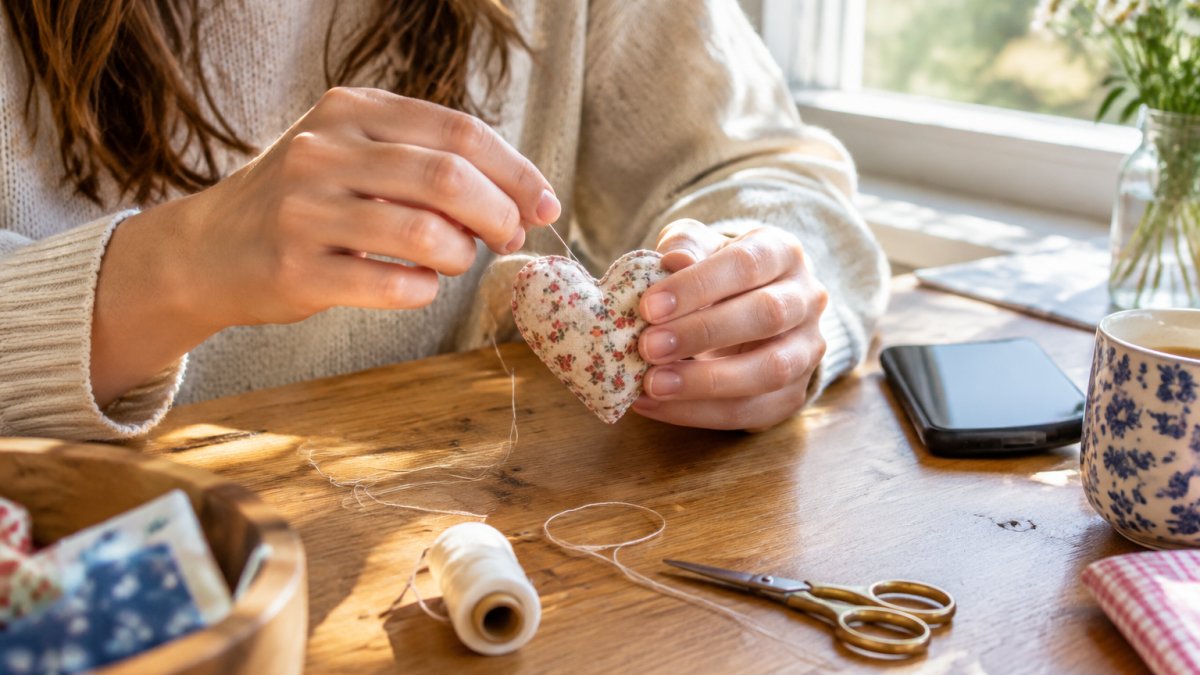
For a curated comparison of beginner-friendly options, our roundup of the best hand embroidery kits for adults is a good next stop. If you would rather start with an all-in-one project, the Needle Felting Starter Kit is Made in the USA and includes a beginner booklet, three color-coded needles, a foam block, and 25 wool colors for $45.00. For a shorter project, the Mini Heart Pillow Sewing Kit comes with 12 precut crushed rayon pieces to make six 5.75" × 5.5" pillows for $12.00.


Making It Stick: Low-Cost, Accessible, Long-Term Creative Habits
Long-term habit formation beats intensity every time. A 20-minute session you repeat weekly will do more for you than a four-hour project you abandon.
Three rules we would follow:
- Keep the setup out. A basket you can pull onto the table beats supplies sealed in a closet.
- Buy for the second project, not the first. Kits with reusable tools cost less per session over a year.
- Lower the bar on bad days. Five minutes of stitching still counts as showing up.
If you want a structured starting point, this guide to starting a creative journal walks through a low-cost format that needs nothing more than paper and a pen. Zero-waste habits fit here too: precut kits reduce fabric scraps, and leftover wool from a felting project can go into the next one.
Start Your First Hands-On Project With Elamae
The research is clear, and the barrier is not. Pick one project, put your phone in another room, and give it 45 minutes.
Elamae is a women-owned small business curating creative kits, experience books, jewelry, and accessories designed to help you notice and try more in ordinary moments, with many products made in the USA. Our Drawing Stitches Embroidery Kit teaches more than fifteen stitches for $39.75, and the Winter Woods Watercolor Painting Kit includes three outlined 8" × 10" designs, twelve professional paint dots, and a brush for $33.00. If you want easy project ideas to try at home first, browse our watercolor painting ideas for beginners.

Get started with Elamae and turn one ordinary afternoon into something you made with your own hands.
Frequently Asked Questions
What are the benefits of hands-on creative activities?
Hands-on creative activities give your hands a steady task to focus on, and finishing a small project can feel rewarding.
Why is working with your hands considered a form of mindfulness?
Tactile work pulls attention to what you can feel: the drag of thread, the give of wool, the wet edge of paint. Many people find it easier to stay with a creative task than a formal meditation session, because there is something to do rather than only something to observe.
I'm not crafty. Will a beginner kit actually get used?
Choose a kit with everything precut and a clear finish line. The Mini Heart Pillow Sewing Kit, $12, comes with twelve precut fabric hearts for six small pillows, so there is no pattern tracing or fabric measuring before you start.
How can creative activities reduce daily stress levels?
Embroidery, felting, and hand sewing give your hands a steady pattern to follow and can narrow attention to one task. Pairing a short session with a phone-free block of time may help you focus.
