

Why Choose Handmade Over Mass Produced: A 2026 Guide
Table of Contents
- Handmade vs. Mass Produced: What Actually Differs
- The Benefits of Handmade Products Go Beyond the Object
- The Case for Mass Produced: Price, Speed, and Consistency
- How to Identify Handmade Products Before You Buy
- Why Buy From Small Businesses? The Money Stays Closer to Home
- Handcrafted Jewelry From Small Businesses: Small Scale, Big Difference
- When Handmade Is Worth It (and When It Isn't)
- Conclusion
- Frequently Asked Questions
Last Updated: October 19, 2026
Handmade vs. Mass Produced: What Actually Differs
Choosing handmade over mass produced comes down to one question: do you want an object with a story, or an object with a barcode? At Elamae, we sell both handcrafted goods and the reasoning behind them, so this guide weighs the real trade-offs instead of romanticizing either side.
Handmade goods are items made in small batches by an individual maker or artisan group, where the maker controls the materials and finish. Mass-produced goods are manufactured in large runs to a fixed specification, which is why two units are identical and why the price is lower.
The difference shows up in three places: how much variation you'll see, how much you'll pay, and how quickly you can reorder. Below, we break down each one so you can decide which matters most for the purchase in front of you.
The Benefits of Handmade Products Go Beyond the Object
The benefits of handmade products extend past the item itself into how it was made and who it supports. A handwoven basket carries the slight irregularity of a real person's hands.
There's also a practical side most buyers don't consider.
Variation as a Feature, Not a Flaw
In handmade work, small differences between units are expected and often desirable. Our Handmade Willow Picnic Basket states plainly that natural variations in color, texture, and weave are part of the product, not a defect. The same goes for our One-of-a-Kind Recycled Sari Fabric Notebook: no two covers match, because each is wrapped by hand.


If you need ten identical items for a corporate order, this is a drawback. If you're buying one gift that should feel like it was chosen for one person, it's the whole point.
The Case for Mass Produced: Price, Speed, and Consistency
Mass-produced wins on three fronts, and it's dishonest to pretend otherwise. Unit cost is lower because tooling and labor are spread across thousands of units. Delivery is faster because inventory sits in warehouses. And consistency is guaranteed: the replacement plate matches the one you broke.
For high-volume, low-emotion purchases, that combination is hard to beat. Disposable party supplies, basic storage bins, everyday kitchen tools: buying these mass produced is a reasonable call, not a compromise.
Where mass production falls short is in the details that make an object feel like yours. A factory can't give a notebook a cover that exists nowhere else. It can't turn a crochet hook from a single piece of rosewood and let the grain decide the character. Those choices cost more time per unit, and that time is what you're paying for.
How to Identify Handmade Products Before You Buy
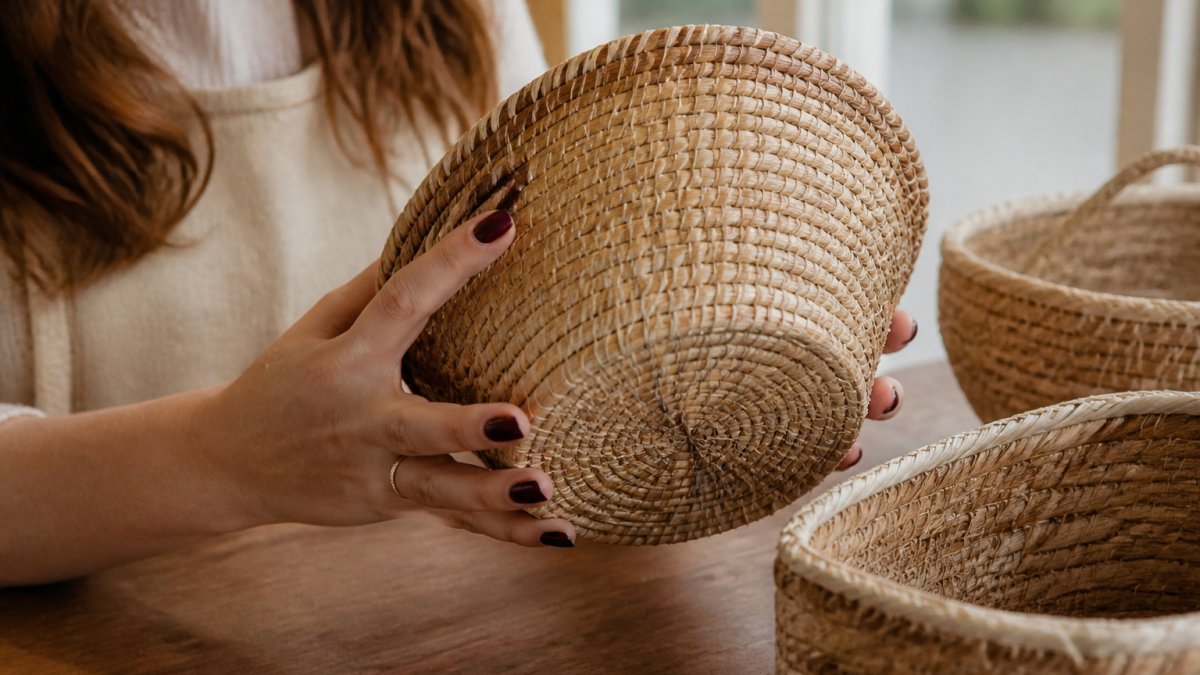
Learning how to identify handmade products takes about two minutes if you know what to look for. Real handcraft leaves traces: tool marks, slight asymmetry, hand-finished edges, and a maker willing to name their process.
Start with these checks:
- Read the material description. Specific materials ("100% natural myrtle wax," "hand-turned Indian rosewood") signal a maker who knows their supply chain. Vague terms like "premium materials" signal a reseller.
- Look for stated variation. Honest handmade listings warn that color, size, or finish will vary. That warning is a good sign, not a red flag.
- Check for a named maker or artisan group. Our candles name the Q'eqchi artisans who hand-dip them. A listing that credits no one probably wasn't made by anyone in particular.
- Ask about lead time. Handmade items often ship in days rather than hours because they're made or finished to order.
Questions That Reveal a Real Maker
A short message to the seller tells you more than any product page. Ask: Who made this piece, and where? What happens if it arrives damaged? Can you tell me which materials you use and why?
A real maker answers specifically and quickly. A drop-shipper deflects or copies boilerplate. The response itself is the test.
Hand-Dipped Myrtle Wax Candles | Set of 10 →
Why Buy From Small Businesses? The Money Stays Closer to Home
The reason to buy from small businesses is straightforward: more of each dollar stays with the people who did the work. A small shop pays its maker, its shipper, and its own rent before it pays a shareholder. That's a shorter chain from your card to a person's hands.
There's a second reason that matters for gifts. Small businesses tend to carry things you can't find in a big-box aisle, because their inventory is chosen by a person with taste rather than an algorithm with a planogram. You're more likely to find something that doesn't look like everything else in the room.
Handcrafted Jewelry From Small Businesses: Small Scale, Big Difference
Handcrafted jewelry from small businesses shows the handmade-versus-mass-produced trade-off at its clearest. A handcrafted piece carries the finish of the person who shaped it, and often a small irregularity that proves a hand was involved.
Take our Silver Bird Ring Holder. It's a small, useful object with a padded base and a nickel-plated finish, and each piece varies slightly because it's handcrafted. That variation is why it works as a gift: it looks like it was picked, not pulled from a shelf.
The same logic applies to tools. Our Sparkle Rosewood Crochet Hook is hand-turned from Indian rosewood with a resin center, and the maker supports fair wages for artisans. You're paying for a tool that fits a hand, not a mold.
When Handmade Is Worth It (and When It Isn't)
Handmade is worth it when the object will be used often, given as a gift, or kept for years. It's also worth it when you want to support a specific maker or a small, women-owned business like ours.
It isn't worth it when you need fifty identical units by Friday, when the item is disposable by design, or when the lowest possible price is the only criterion. Those are legitimate needs, and mass production serves them well.
Here's the short version:
| Situation | Better Choice | Why |
|---|---|---|
| A gift for one person | Handmade | Unique, story attached |
| Bulk event supplies | Mass produced | Cost and identical units |
| A piece used daily for years | Handmade | Repairable, made to last |
| A disposable or seasonal item | Mass produced | Low cost, easy replacement |
| Supporting a small maker | Handmade | Money stays with the maker |
| Fast replacement of a broken staple | Mass produced | In stock, ships quickly |
Conclusion
The honest answer to why choose handmade over mass produced is that it depends on what you're buying and why. When the object should feel like it belongs to one person, handmade earns its higher price. When you need volume and speed, mass production wins.
At Elamae, we curate handcrafted pieces from small makers, including our Hand-Dipped Myrtle Wax Candles and the rest of our collection, because we think everyday objects should carry a little meaning. Shop Elamae and find something made by a person, for a person.

Frequently Asked Questions
Why do people prefer handmade products over mass-produced ones?
Most buyers point to three things: character, quality, and connection. A handmade piece usually carries small variations that make it distinct, and the maker often works with materials they chose themselves. Buyers also like knowing who made an item and that their money supports a real person rather than a factory line. Mass-produced goods win on price and consistency, but they rarely carry a story. If you want an object that feels like yours and holds up as a conversation piece, handmade usually delivers more per dollar over time.
How can you tell if a product is genuinely handmade?
Look for small irregularities that a machine would not produce: slight differences in stitch tension, weave density, finish, or color placement. Read the listing for maker details, materials, and where the item was made. Ask directly who made it and how. A real maker answers with specifics, such as the artisan's name, the workshop, or the technique used. Vague claims like "artisan-inspired" or "hand-finished" are worth questioning. Photos showing the same item in multiple variations are a good sign, since one-of-a-kind pieces cannot be photographed identically twice.
Are handmade products better quality than mass-produced products?
Not automatically, but the odds are better when you buy from a maker who stands behind the work. Handmade goods are usually produced in smaller batches with more attention per item, and many makers choose materials they can vouch for. Mass production can hit tight tolerances, but it also optimizes for speed and cost. The practical test is the maker's willingness to answer questions and stand behind the piece. A handcrafted item with a clear maker is a safer bet than an anonymous factory product at the same price.
Do handmade products support small businesses and local economies?
Yes, and that is one of the strongest reasons to buy from small businesses. When you buy from an independent maker, most of the money stays with that person or workshop rather than flowing to a large retailer's margin. Small businesses also tend to source closer to home and hire locally. That matters if you care about keeping craft skills alive and want your purchases to reflect your values. The trade-off is usually price: handmade costs more because the labor is real and the batches are small.