

Watercolor Paper vs Mixed Media Paper for Beginner Painters
Last Updated: November 10, 2026
Quick Summary
Watercolor paper is engineered for water, with loosely compressed fibers that absorb paint and stay flat under wet washes. Mixed media paper uses tighter, denser fibers that resist water, making it better for drawing, ink, and light paint. Neither is better; they solve different problems.
- Watercolor paper is traditionally made from cotton or a cotton-cellulose blend with long, resilient fibers.
- Both paper types commonly come in 190gsm and 300gsm weights, with 300gsm often labeled 140 lb.
- Cold press has a medium grain that holds water and creates soft, mottled washes.
- Mixed media paper handles acrylic well at thin consistency and is the better surface for alcohol markers.
- Tape the sheet down on all four sides before wetting it to prevent buckling.
Table of Contents
- Watercolor Paper vs Mixed Media Paper: The Core Differences
- Paper Weight, Thickness, and What GSM Means for Your Paint
- Surface Texture and Tooth: Cold Press, Hot Press, and Rough
- Mixed Media Paper for Watercolor: What It Handles and Where It Struggles
- What Is Mixed Media Paper Used For? Beyond Watercolor
- Is Mixed Media Paper Good for Acrylic and Alcohol Markers?
- Choosing Your Paper: A Decision Guide by Technique and Skill Level
- Shop Elamae Watercolor Kits and Start Painting
- Frequently Asked Questions
Watercolor Paper vs Mixed Media Paper: The Core Differences
Watercolor paper is a surface engineered for water, while mixed media paper is a surface engineered for versatility. That single distinction explains almost every difference you will feel under a brush. According to Strathmore's paper comparison guide, watercolor paper fibers are loosely compressed so paint penetrates deep, while mixed media paper uses tighter, more compressed fibers with fewer gaps. At Elamae, we hear from beginners who bought a mixed media sketchbook, tried a wet wash, and watched it pucker within seconds. This guide breaks down paper weight, texture, absorbency, and medium compatibility so you pick the right sheet the first time.
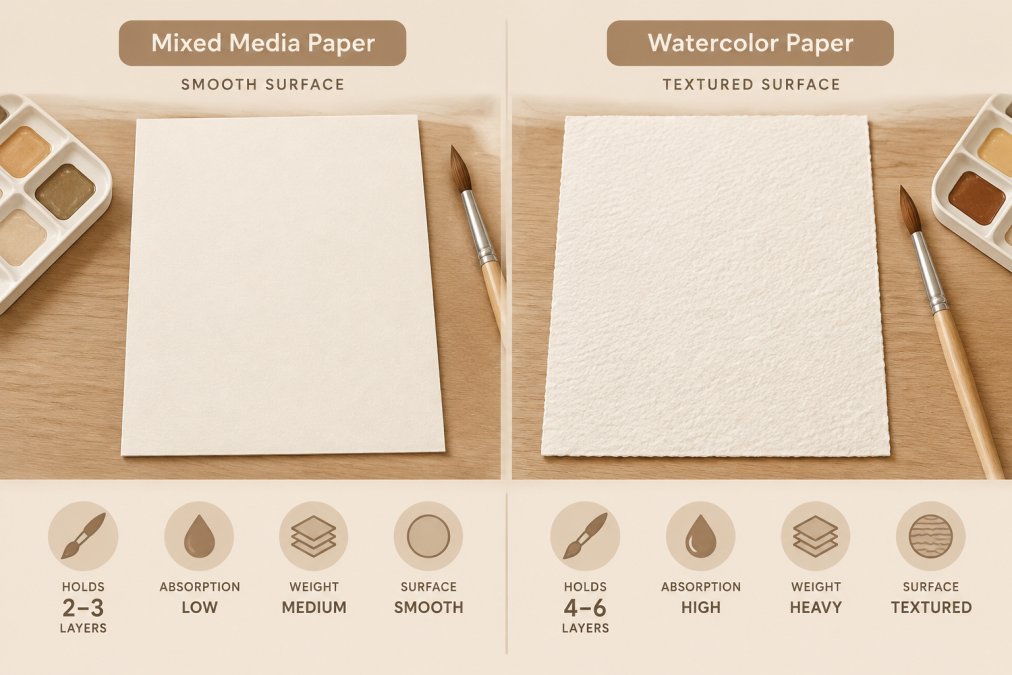
Here is the short version:
| Feature | Watercolor Paper | Mixed Media Paper |
|---|---|---|
| Fiber compression | Loose, open fibers | Tight, dense fibers |
| Water absorption | High, controlled | Low to moderate |
| Best for | Wet washes, glazing | Drawing, ink, light paint |
| Buckling risk | Low at 300gsm | Higher with heavy water |
| Texture options | Cold press, hot press, rough | Usually smooth or light grain |
The practical upshot: watercolor paper absorbs water and stays flat. Mixed media paper resists water and stays workable for dry media. Neither is "better", they solve different problems.
Paper Weight, Thickness, and What GSM Means for Your Paint
GSM stands for grams per square meter, and it measures paper density, not just thickness. Both paper types commonly come in 190gsm and 300gsm weights, according to Strathmore's mixed media vs. watercolor paper breakdown. The 190gsm sheets suit practice and light washes.
Weight is only half the story. What a sheet does under water also depends on its fiber composition and how it is sized.
Fiber composition. Watercolor paper is traditionally made from cotton or a cotton-cellulose blend, and cotton's long fibers interlock into a resilient sheet that swells and recovers without tearing.
Internal versus surface sizing. Sizing is the treatment that controls how fast water soaks in.
Acidity and permanence. Look for the words "acid-free" and "archival" on the pad. Acidic pulp yellows and embrittles over time, and a watercolor wash accelerates the damage because it keeps the sheet damp longer.
Weight versus stretching. Heavier stock gives you a fighting chance, but weight does not replace preparation. A 140 lb sheet taped down dry will still cockle under a saturated wash; the same sheet soaked, stretched, and stapled will dry flat.
Our rule of thumb for beginners: start at 140 lb. It forgives more mistakes, absorbs a learning-curve wash without rippling, and costs only slightly more per sheet than lighter stock.
Surface Texture and Tooth: Cold Press, Hot Press, and Rough
Tooth is the microscopic grain on a paper's surface, and it decides how paint and pigment behave. Cold press has a medium, slightly bumpy grain that holds water and creates soft, mottled washes. Hot press is smooth and slick, ideal for fine detail and controlled color lifting. Rough has a pronounced, heavy texture that grabs pigment and produces sparkle in dry-brush work.
Mixed media paper usually runs smooth or lightly grained. That smoothness is a feature for pen and ink, but it works against you in wet-on-wet painting, where a textured surface helps water pool and bloom.
If you plan to control water on a textured sheet, a Medium Water Brush lets you release water straight through the bristles, so you are not fighting a cup and a loaded round brush at the same time.

Mixed Media Paper for Watercolor: What It Handles and Where It Struggles
Mixed media paper can handle watercolor, but only within limits. It accepts light washes, quick studies, and layered glazing if you keep each layer thin and let it dry fully between passes. Where it struggles is heavy water: large wet-on-wet areas, saturated washes, and repeated lifting will cause the surface to pill, buckle, or lose its sizing.
Mixed media paper is designed to accept dry drawing, ink, markers, and light paint, per Paul Rubens' sketchbook specifications. Watercolor paper is specifically engineered for water control and paint absorption. That engineering gap is why some artists report mixed media barely accepts watercolor at all, per Watercolor Misfit's surface comparison.
Mixed media is well suited to sketchbook practice and light color studies. Reach for real watercolor paper when the wash is the point.
What Is Mixed Media Paper Used For? Beyond Watercolor
Mixed media paper is used for drawing, ink work, markers, colored pencil, collage, and light acrylic or gouache studies. Its tight surface holds fine lines without feathering and takes erasure better than loose-fibered watercolor stock.
The compressed fiber structure is the reason. Fewer gaps mean ink sits on top rather than bleeding along the grain, per Flax Art & Design's fiber density explainer. That makes mixed media the better choice for illustrated journaling, urban sketching, and any page where line work shares space with color.
Where it falls short: layering wet media repeatedly. A single light wash is fine. Five glazed layers will start to lift the surface.
Is Mixed Media Paper Good for Acrylic and Alcohol Markers?
Yes, with caveats. Mixed media paper handles acrylic paint well at thin consistency, and it is one of the better surfaces for alcohol markers because the smooth, sealed surface stops ink from bleeding through.
Acrylic on mixed media works best when you keep coats thin. Heavy body acrylic will crack on a flexible paper surface. For alcohol markers, mixed media beats watercolor paper outright: the textured grain of cold press eats marker tips and muddies color.
Watercolor paper, by contrast, drinks acrylic medium and can warp under thick application. If markers and acrylic are your main media, mixed media is the correct pick.
Choosing Your Paper: A Decision Guide by Technique and Skill Level
Match the paper to the technique, not the other way around. The matrix below is the part most comparisons skip: it separates the technique from the medium and from the skill level, because a beginner doing wet-on-wet and an experienced painter doing the same wash need different sheets.
| Technique | Best surface | Why |
|---|---|---|
| Wet-on-wet washes | 300gsm cold press or rough watercolor paper | Open fibers hold the pooling water and let color bloom |
| Glazing (layered transparent washes) | 300gsm hot press or cold press watercolor paper | Surface sizing lets each layer sit without lifting the one below |
| Lifting and scrubbing | 300gsm cold press watercolor paper | Dense cotton fiber tolerates repeated abrasion |
| Ink and line work over color | Mixed media paper, smooth | Tight surface stops feathering along the grain |
| Alcohol markers | Mixed media paper, smooth | Sealed surface resists bleed-through |
| Colored pencil and graphite | Mixed media paper or hot press watercolor paper | Fine tooth holds pigment without shredding the point |
| Light gouache studies | Mixed media paper | Opaque paint hides the surface; heavy water is not required |
| Acrylic, thin coats | Mixed media paper | Accepts thin acrylic without the warping watercolor paper shows under medium |
| Sketchbook practice and warm-ups | 190gsm either type | Cheapest per sheet; buckling is acceptable |
By skill level. Absolute beginners testing watercolor should start on 140 lb cold press watercolor paper: it forgives wet washes and teaches you how water moves. Sketchbook journalers mixing ink and light color should use mixed media paper so line work stays sharp. Wet-on-wet landscape painters should move to 300gsm rough or cold press. Practice and warm-ups can run on 190gsm of either type, whichever is cheaper per sheet.
Preventing buckling before it starts. Buckling is the most common reason a beginner blames the paper. Tape the sheet down on all four sides with artist's tape before you wet it, or soak the sheet, staple it to a board, and let it dry flat before painting.
Cost per usable sheet, not per pad. Pad price is misleading. A cheap pad that buckles wastes every sheet you tape down, while a slightly pricier 140 lb block gives you a finished artwork every time. For a beginner ready to paint, our Spring Florals Watercolor Painting Kit Large pairs 140 lb premium cold-press watercolor paper with professional paint dots, so the paper question is already answered.

Shop Elamae Watercolor Kits and Start Painting
Elamae's Winter Woods, Fall Harvest, and Spring Florals large watercolor kits include 140 lb premium cold-press watercolor paper, Da Vinci Paint Co. professional watercolor paint dots, a size 4 round brush, a compostable palette, digital paint-along videos, and a bonus Watercolor Basics Course.
If you want a low-commitment start, the Bug Hikes Mini Watercolor Painting Kit gives you three outlined 5" × 6" designs to practice washes on real watercolor stock. Ready for a bigger project? The Garden Veggies Watercolor Painting Kit Large sets up three full 8" × 10" designs on the same premium cold-press paper.

The paper you choose shapes every wash you make. Start with watercolor paper for wet media, keep mixed media for line and dry work, and let each surface teach you something. Elamae curates creative kits with premium cold-press paper, professional paints, and guided videos so beginners can notice, try, and enjoy the process. Get started with Elamae and paint your first wash on paper that works with you.
Frequently Asked Questions
Can mixed media paper be used for watercolor?
Yes, but with limits. Mixed media paper is designed to accept light paint, ink, and markers, so it can handle small watercolor studies and practice washes. Its more compressed fibers and fewer gaps mean paint sits closer to the surface and absorbs less deeply than on watercolor paper. For serious wet-on-wet work or heavy glazing, dedicated watercolor paper such as the 140 lb cold-press sheets in Elamae's painting kits gives you better water control and less buckling.
What is the difference between mixed media paper and watercolor paper?
The main difference is fiber structure and sizing. Watercolor paper has loosely compressed fibers that let paint penetrate deeper, plus surface sizing for water control. Mixed media paper has more compressed fibers and fewer gaps, making it sturdier for dry media like colored pencil and ink while still accepting light paint. Both commonly come in 190 gsm and 300 gsm weights, but watercolor paper is engineered specifically for water absorption and repeated washes.
Is mixed media paper good for acrylic paint?
Mixed media paper can handle acrylics, especially lighter applications and small studies. Its compressed surface resists some water penetration, which helps with acrylic's heavier body compared to watercolor. However, thick acrylic layers or heavy impasto may cause warping on lighter weights. Choose a 300 gsm mixed media pad for acrylic work, or use the 140 lb cold-press watercolor paper included in Elamae's large painting kits for more structured support.
Is mixed media paper good for alcohol markers?
Mixed media paper is a solid choice for alcohol markers because its compressed fibers and tighter surface prevent the ink from bleeding through as quickly as it would on loosely compressed watercolor paper. Markers lay down color smoothly on the tooth of mixed media sheets. For blending and layering, a heavier 300 gsm mixed media pad works best. Watercolor paper's open fibers would let alcohol ink spread and feather, so keep the two surfaces separate for marker work.
What is mixed media paper used for?
Mixed media paper is built for combining dry drawing, ink, markers, and light paint in one piece. Artists use it for sketchbook practice, colored pencil studies, ink and wash illustrations, and mixed-technique journaling. Its compressed fibers hold up to erasing and layering better than watercolor paper. If you want to test multiple materials without committing to a single medium, a mixed media pad is the practical starting point before moving to dedicated watercolor sheets.
