

Are DIY Kits Worth the Money? An Honest 2026 Review
Table of Contents
- The Real Verdict on DIY Kits: What You Actually Get
- DIY Kit Cost: The Full Breakdown Nobody Shows You
- DIY Kit Reviews: How to Judge Quality Before You Buy
- DIY Kit vs Ready-Made: Which One Wins for Your Money?
- DIY Kits for Beginners: What to Expect From Your First Build
- The Best DIY Kits for Women Who Want a Hands-On Project
- Conclusion
- Frequently Asked Questions
Last Updated: October 21, 2026
The Real Verdict on DIY Kits: What You Actually Get
Are DIY kits worth the money? Yes, for most people, because you pay for an experience and a finished object at once.
A kit is a guided project, not a magic trick. You still do the work.
At Elamae, we curate creative kits for women who want a hands-on outlet without hunting down twelve separate supplies.
Below, we break down real costs, quality signals, and how kits compare with buying ready-made.
DIY Kit Cost: The Full Breakdown Nobody Shows You
Most DIY kit reviews quote the sticker price and stop there. The real DIY kit cost includes what the box does not contain, and the only fair comparison is an all-in total against the ready-made alternative.
Take our DIY Fire Cider Kit at $16.00. It includes freeze-dried ginger, horseradish, garlic, lemon, onion, rosemary, turmeric, cayenne, jalapeños, and instructions. You still need apple cider vinegar, honey, a jar, and a strainer, the honest shape of a kit build.

The Hidden Line Items: Tools, Finishing, and Replacements
Three cost categories get left out of most kit write-ups:
- Reusable tools. A sewing needle, thread, and Poly-Fil stuffing for the Mini Heart Pillow Sewing Kit ($12.00). Buy once, use for years.
- Consumables you finish. Vinegar and honey for the fire cider. Stuffing for the pillows. These repeat if you rebuild.
- Replacement parts. Thread snaps, needles bend, paint runs out. Budget a small buffer.
Building an All-In Budget
A realistic all-in total has four lines:
- Kit price. The number on the box.
- Consumables the kit omits. Vinegar, honey, stuffing, extra paint, or seed-starting medium.
- Reusable tools you do not already own. Scissors, a strainer, a jar, a brush you actually like.
- A rework buffer. A small allowance for the mistake every first build includes.
Run that math on two of our kits. The Mini Heart Pillow Sewing Kit at $12.00 is close to its sticker price if you already own a needle, thread, and stuffing; if you own none, the all-in figure climbs toward a single store-bought decorative pillow, and the six finished pieces tip the comparison.
A kit that costs $12.00 but requires $30.00 of tools you will never touch again is a $42.00 project. Write the four lines down before you buy, and the decision usually makes itself.
Kit Cost vs. Ready-Made Cost
The fair comparison is all-in kit cost versus the ready-made item you would otherwise buy.
- A ready-made item bundles someone else's labor, tools, and skill into one predictable price. You pay for the result and nothing else.
- A kit spreads the cost across materials, tools you keep, and hours of your own time. You pay for the result plus the process, and the tools stay for the next project.
A kit whose all-in cost lands near the ready-made price is a strong buy, because you keep the tools and the skills. A kit whose all-in cost runs well past the ready-made price is only worth it if the making itself is the point.
Where the Money Actually Goes
A kit's price is a budget in miniature. In a well-made kit, most of the money goes to materials and components, with a smaller share to instructions and packaging.
A kit that will not list its materials is a cost risk, not just a quality risk: you cannot budget for what you cannot see. Read the component list like a receipt.
DIY Kit Reviews: How to Judge Quality Before You Buy
Good DIY kit reviews answer one question: will the materials hold up in your hands? Most reviews skip that and describe the packaging instead. Here is what to look for.
Component-by-Component: What Separates a Good Kit From a Bad One
Judge a kit by its weakest component, not its strongest. A beautiful box with a flimsy brush is a bad kit with good marketing.
| Component | Weak Kit Signal | Strong Kit Signal |
|---|---|---|
| Materials | Vague or unlisted | Named brands and weights |
| Instructions | Generic steps | Photos, video, or a course |
| Tools included | Missing or flimsy | Sized and specified |
| Extras | None | Palette, guide, or recipe card |
| Packaging | Loose bag | Labeled, gift-ready box |
The Winter Woods Watercolor Painting Kit is a useful example of the strong column: 140 lb cold-press paper, twelve Da Vinci Paint Co. professional paint dots, a custom size 4 round brush, digital paint-along videos, and a bonus Watercolor Basics Course.

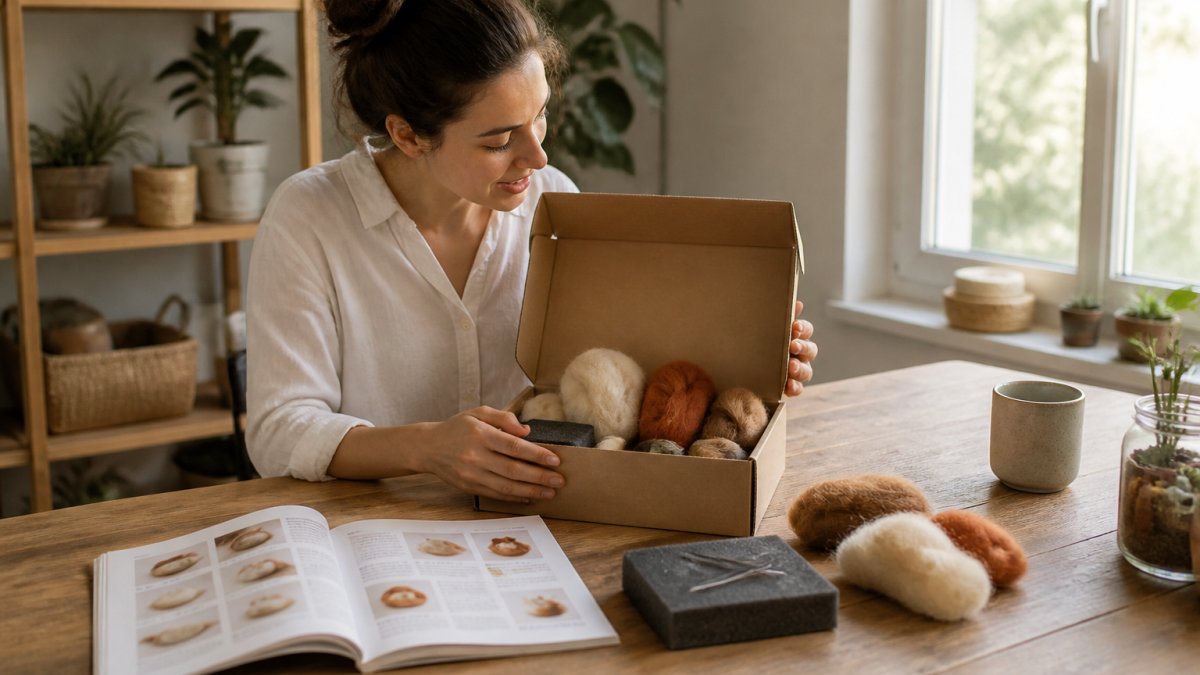
The Needle Felting Starter Kit does the same thing. It names three color-coded needles (#36T, #38T, #40T), a high-density foam block, 25 wool colors at 0.1 oz each, and 0.5 oz of core wool.
DIY Kit vs Ready-Made: Which One Wins for Your Money?
Neither wins outright. DIY kit vs ready-made comes down to what you are buying: a process or a product. A ready-made item is faster and more predictable. A kit is slower and less predictable, but you keep the skills and the story.
- Choose ready-made when the object matters more than the making, or when you need a guaranteed result.
- Choose a kit when the hours spent making count as part of the value, or when you want a custom finish.
- Choose a kit when the finished piece will be a gift with meaning attached.
The Microgreens & Seed-Starting Kit ($34.00) shows the split clearly. You could buy microgreens at the store today; growing five batches yourself, with some varieties ready in as little as seven days, trades convenience for the satisfaction of eating something you grew on your counter.
DIY Fire Cider Kit | Make Your Own Spicy Infusion →
DIY Kits for Beginners: What to Expect From Your First Build
Your first build will take longer than the box suggests, and that is normal. DIY kits for beginners are designed to be forgiving, not fast. Expect to read the instructions twice and make one fixable mistake.
Skill Level and Time Commitment by Task
Time estimates are the most useful thing a beginner can know before buying. Here is the honest breakdown by task type.
- Sewing a small pillow: under an hour per piece, and the skill is straight seams and even stuffing. The Mini Heart Pillow Sewing Kit makes six, so plan a few evenings.
- Watercolor painting: one to two hours per design, plus drying time, and the skill is brush control and layering. The Winter Woods kit includes three designs.
- Needle felting: one to three hours for a first simple shape, longer as you get ambitious, and the skill is patience with a barbed needle.
Separate the tasks inside a kit and the commitment gets clearer. Assembly is usually the short part. Sanding, finishing, wiring, and setup are where the hours hide. A kit that promises a one-evening build is usually counting assembly only.

What Can Go Wrong, and What You Can Fix
Most first-build mistakes fall into three buckets:
- Repairable in the moment. A crooked seam, an uneven felt shape, a paint edge that bled. These are fixable with a seam ripper, a little more wool, or a second coat.
- Repairable with a redo. A pillow stuffed too loosely, a watercolor washed out by too much water. You lose time, not the kit.
- Not repairable. A scorched finish, a snapped needle with no spare, a batch of seed medium that molded. These are the ones a rework buffer is for.
The first piece is usually the worst and the last the best, that is the learning curve, and it flattens fast. Plan your first attempt on a practice piece when the kit allows it. Check warranty and returns before you buy: most craft kits cover missing or damaged components on arrival, not mistakes you make during the build.
Which Buyer Are You?
The right kit depends less on the product than on the person holding it:
- The curious beginner wants a fast, forgiving win. Start with the smallest kit and finish it in one sitting.
- The hobbyist wants a skill to grow into. A kit with real materials and video instruction, like the watercolor set, rewards repeat use.
- The experienced maker wants components worth upgrading. Check the materials list for named brands and standard sizes before buying.
One more thing nobody tells beginners: your first result will not match the product photo. That is not failure, it is the same learning curve every maker climbs.
The Best DIY Kits for Women Who Want a Hands-On Project
The best kit is the one you will actually finish. A kit that sits on a shelf is the most expensive thing you can buy.
We built our collection around that idea. Every Elamae kit is chosen for a clear starting point, usable materials, and a finished piece worth keeping or giving. Many of our products are made in the USA, and we are a women-owned small business.
Here is how our current kits sort by temperament:
- Want a fast, tangible win? The Mini Heart Pillow Sewing Kit ($12.00) gives you six small finished pieces.
- Want to learn a real skill? The Winter Woods Watercolor Painting Kit ($33.00) pairs professional paints with video instruction.
- Want a meditative afternoon? The Needle Felting Starter Kit ($45.00) is made in the USA and beginner-friendly.
If you are not a "crafty" person, start with the smallest kit. Finishing something small builds more momentum than starting something grand.
Conclusion
The honest answer to whether DIY kits are worth the money is that it depends on what you count.
Elamae exists for the second kind of buyer. Our creative kits are curated for clear starting points, real materials, and finished pieces that add character to everyday life.
Start with one small kit. Finish it. Then decide what the money was really for.
Frequently Asked Questions
Are DIY kits actually worth the money?
It depends on what you count as the return. If you only compare the finished object to a store-bought equivalent, a DIY kit often costs more per item once you add tools, finishing supplies, and your time. If you count the hours of hands-on activity, the skills you pick up, and the customization you get, most kits deliver strong value. The honest test is whether you would pay for the experience itself, not just the end product.
How much does a DIY kit cost?
Kit prices vary widely by category and component quality. Elamae's range runs from $12.00 for a Mini Heart Pillow Sewing Kit that makes six pillows, up to $45.00 for a Made-in-the-USA Needle Felting Starter Kit with 25 wool colors and three felting needles. The Winter Woods Watercolor Painting Kit is $33.00, the Microgreens & Seed-Starting Kit is $34.00, and the DIY Fire Cider Kit is $16.00. Budget extra for consumables the kit does not include, such as stuffing, vinegar, or honey.
Do DIY kits include everything you need?
Most do not, and the listing should tell you exactly what is missing. The Mini Heart Pillow Sewing Kit includes twelve precut fabric pieces but requires Poly-Fil stuffing, needle, and thread. The DIY Fire Cider Kit supplies the herbs and spices but not the apple cider vinegar or honey. The Microgreens & Seed-Starting Kit includes trays, domes, seeds, and soil wafers. Read the 'you'll also need' line before buying so a missing item does not stall your project.
Are DIY kits worth it for beginners?
Yes, if you pick a kit built for first-timers. Look for precut pieces, a printed guide, and a defined finished size. The Needle Felting Starter Kit includes a beginner booklet and color-coded needles, and the Winter Woods Watercolor Painting Kit adds digital paint-along videos and a basics course. Beginners should avoid kits that assume prior woodworking or soldering experience, and should start with a project that fits in one sitting.
How do I compare the value of a DIY kit with a ready-made product?
Add up the kit price, any missing supplies, and the hours of use you will get. A $12.00 sewing kit that makes six pillows and fills two afternoons costs less per hour of activity than most entertainment. A ready-made version of the same item may be cheaper per unit but gives you no project. Compare on cost per hour of engagement and on whether you want customization, not just on the sticker price of the finished object.